



Alexandra Bell, Hashwitaa Maynoor & Lachlan Wilkinson
Just 10 days after the terrorist attack at Bondi Beach in December 2025, the NSW Government enacted sweeping new legislation expanding police powers to restrict public assemblies across Sydney. The Public Assembly Restriction Declaration (PARD) scheme was the latest in a series of measures by state governments attempting to crack down on protests. In this case, the NSW Government reasoned that large protests had the potential to undermine “social cohesion” and place the community at risk during periods of heightened tension following a terrorist attack. Under the PARD scheme, the NSW Police Commissioner was empowered to suspend the protest authorisation system which has long been a critical safeguard for protesters in NSW because of the legal protections it offers.
On 16 April 2026, the NSW Court of Appeal declared that the legislation establishing the PARD scheme was constitutionally invalid, as it constituted an “impermissible burden” on the implied freedom of political communication, which is a fundamental limitation on legislative or other government power.
The impact of the NSW Government’s approach to regulating “social cohesion” became apparent when more than 6,000 people gathered in Sydney’s Town Hall earlier this year to protest the visit of Israeli President Isaac Herzog. In the lead-up, the NSW Government declared Herzog’s visit a “major event”, enlivening additional police powers under the Major Events Act 2009 (NSW) to manage “crowd safety”. The Palestine Action Group unsuccessfully challenged the “major event” declaration in the Supreme Court. At the same time, a PARD was applied to the area around the immediate vicinity of Town Hall, restricting the protest from being “authorised within designated areas”. Together, these measures created a more restrictive protest environment, severely limiting protesters’ ability to demonstrate peacefully and safely.
The question of “where the line between lawful and unlawful protest activity should be drawn” has again been at the centre of recent debates between government, law enforcement, human rights activists and civil society stakeholders.
Why is the right to protest so fundamental?
In Australia’s liberal democracy, the right to protest is a critical form of communication that reflects the accommodation of minority opinion. It is understood that the right to protest generally cannot operate without reasonable limits. However, any limitations imposed must be legitimate and justified in every democratic, pluralistic society that upholds human rights.
Protest has long served as a powerful engine for civil rights and political progress in Australia, providing a vital avenue for those whose interests are often ignored by the political system. Many cherished facets of Australian social and political life are rooted in acts of civil disobedience and collective demonstration. The campaign for women’s suffrage, propelled by lobbying and mass petitions, positioned Australia as a global pioneer; union-led strikes and marches secured the 40-hour work week; and the green bans of the 1970s, orchestrated by the NSW Builders Labourers' Federation, preserved heritage areas such as Kelly’s Bush and The Rocks. Protests like the Aboriginal Tent Embassy and countless marches have been instrumental in advancing Indigenous land and voting rights, whilst persistent activism by environmentalists led to the conservation of the Franklin River. Advocacy led by LGBTQIA+ communities contributed to the legalisation of same-sex marriage in 2017, and the legacy of the '78ers struggle against the criminalisation of homosexuality is now memorialised by the Sydney Mardi Gras.
What is the legal foundation for the right to protest in Australia?
The right to protest is enshrined in international law primarily through the guarantees of freedom of expression and peaceful assembly contained in the International Covenant on Civil and Political Rights (ICCPR). By virtue of its ratification of the ICCPR, Australia is legally bound to ensure that individuals within its territory and jurisdiction are afforded the rights outlined in the ICCPR. This includes the right to freedom of expression (Article 19), and peaceful assembly (Article 21), including by adopting domestic laws which give effect to these internationally protected rights (Article 2).
Australia operates under a dualist legal system, where international laws (such as the ICCPR) must be implemented through domestic mechanisms to have direct legal effect. While Australia does have legal frameworks in place to reflect the right to protest - including the constitutionally implied freedom of political communication, the common law, and the various state and territory legislative schemes - these protections are piecemeal and do not holistically give effect to the rights contained in the ICCPR.
Currently, there is no Federal Human Rights Act that protects the right to protest in Australia. Moreover, unlike Victoria, Queensland and the ACT, NSW lacks a state-level Human Rights Act. Although a private member’s Human Rights Bill was introduced to the NSW Parliament in 2025 and is currently the subject of an inquiry, no such legislation is yet in place. As a result, the right to protest in NSW remains particularly vulnerable. Moreover, the inability of existing legislative scrutiny mechanisms in NSW to prevent encroachments means this right is exposed to potential legislative curtailment.
Increasing legislative curtailment of the right to protest in NSW
There has been a pattern of NSW Government efforts since 2014 to suppress peaceful protests with an initial focus on climate activism. Both Coalition and Labor NSW governments have argued that legislators must strike a balance between the interests of protestors exercising their rights to freedom of speech and assembly on the one hand, and the rights of the broader public to not have their lawful activity impeded, on the other.
In 2022, the NSW Parliament passed legislation that established several new offences concerning “damage” and “disruption” to major facilities, such as certain ports and roads. These new laws also introduced harsh penalties, with jail time of up to two years and fines of up to $22,000. The 2022 legislative amendments were framed in terms of cracking down on “selfish, economic vandalism” by climate protesters bringing “mayhem” to critical infrastructure facilities and were rooted in protecting business from certain “disruptions” that pose a “danger” to the expectation of the constant free movement of capital and people.
In February 2025, amendments to the Crimes Act 1900 (NSW) and the Law Enforcement (Powers and Responsibilities) Act 2002 (NSW) (LEPRA) were passed, introducing new offences for blocking or impeding access to, or harassing individuals near places of worship. The amendments also expanded the powers of police to issue move-on directions in relation to apparently genuine demonstrations and protests occurring in, or near, places of worship. The February 2025 amendments to LEPRA were the subject of a successful constitutional challenge in June 2025.
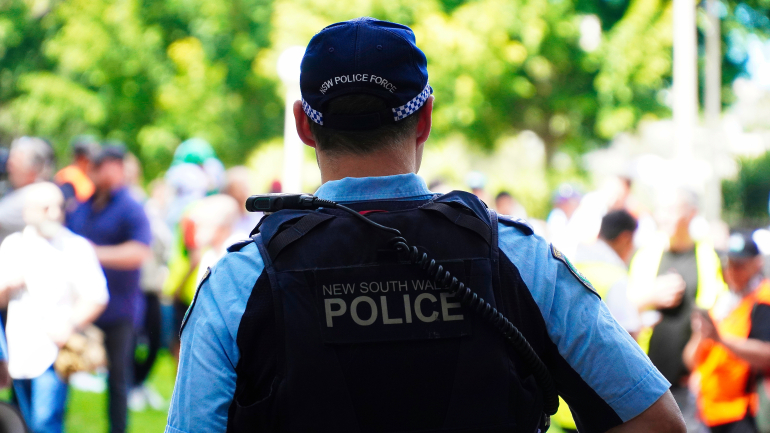
In December 2025, following the Bondi Beach terrorist attack, further amendments were made to several pieces of legislation, including the Crimes Act 1900 (NSW), the Law Enforcement (Powers and Responsibilities) Act 2002 (NSW), the Summary Offences Act 1988 (NSW) and the Terrorism (Police Powers) Act 2002 (NSW). The post-Bondi amendments expanded the powers of police to manage protests, including by expanding police move-on powers, enabling PARDs and enabling the forced removal of face coverings. These amendments were justified based on the notion of “social cohesion” and “public order”.
These trends seen in NSW have also been reflected in other states. In Victoria, for example, legislation passed in December 2025 introduced new restrictions on protest rights, including banning the use of “dangerous” attachment devices and restrictions on protests around places of worship. These Victorian laws have been described by Amnesty International Australia as “overly broad” and “disproportionate”. Moreover, in March this year, Queensland enacted some of the strictest hate speech reforms in the country, banning specific protest phrases, with the first of multiple arrests being made only hours after the laws came into effect.
Challenges to the NSW laws restricting the right to protest
In Australia, there is an implied freedom to communicate information and opinions about matters relating to the government of the Commonwealth. The implied freedom was first recognised in Nationwide News v Wills, where the High Court of Australia articulated the freedom as necessary to maintain a responsible and representative government as prescribed by the Constitution.
In 2022, in response to the anti-protest legislative amendments targeting climate protesters, a non-partisan activist group, the ‘Knitting Nannas’, took legal action to defend the right to protest. They argued that the 2022 legislative amendments to the Crimes Act 1900 (NSW) impermissibly burdened the implied freedom of political communication, and the Court agreed that it did. The Court found that the impugned provisions infringed upon the implied freedom beyond “valid existing laws”, and this had an “incremental effect on the real world ability of a person or persons to have others receive communications which are capable of bearing on electoral choice”.
In June 2025, the legislative amendments passed in February 2025 that expanded police powers to direct protesters to move on or to desist from protesting if they were “in or near a place of worship”, were also struck down based on the implied freedom of political communication.
More recently, in April 2026, a decision by the NSW Court of Appeal held that the PARD scheme is constitutionally invalid. The Court noted that the PARD scheme imposed a burden on the implied freedom of political communication in that it had the effect of restricting and discouraging public assemblies from occurring within a declared area when the power to make a PARD was exercised. It also found this burden was not imposed to fulfil a constitutionally legitimate purpose, and the means adopted were not reasonably appropriate and adapted to achieve that purpose.
Notably, the Court interrogated the NSW Government’s stated legislative purpose, being to seek to discourage all forms of public assembly across a nominated geographical area in order to protect “social cohesion”. The Court noted the paradoxical nature of the government's attempted justification of the law, in that the conception of civil life and “social cohesion” is actually at odds with the system of representative and responsible government. The Court stated at [146]:
The system of representative and responsible government entrenched by the Constitution, involving a free and true choice by the electors, entails acceptance of the potential for disharmony, incivility and disruption that is part and parcel of democratic intercourse. That is reflected in the longstanding recognition that the protection of dissent is at the heart of the implied freedom.
Moreover, protests across NSW have not been treated alike, raising pressing questions about which forms of dissent are considered unacceptable, and whose expressions of dissent are deemed most threatening by lawmakers. On Saturday, 8 November 2025, despite the legislative amendments in NSW, a neo-Nazi protest took place outside the NSW Parliament. It involved 60 men, clad in black, standing in rows amid a banner reading “Abolish the Jewish Lobby”. The protest was organised by the National Socialist Network (also known as “White Australia”), who notified NSW Police of the gathering 12 days before it was set to occur. Upon receiving this notice, it was open to the NSW Police Commissioner to apply to the NSW Supreme Court to seek a prohibition order, effectively opposing the group’s application to protest. However this was not done, meaning the protest proceeded as an “authorised public assembly”.
The passive authorisation of a blatantly anti-semitic protest raised significant grounds for scepticism, with NSW Greens MLC Sue Higginson stating:
“How can [the Police] justify not challenging a rally for neo-Nazis to engage in antisemitism, but relentlessly challenging protests calling for a free Palestine?”
Further, leaving a neo-Nazi protest unopposed, in any capacity, appears to contradict the NSW Government’s own push for “social cohesion”, “public order” and the “free movement” of people. In effect, the legislative justification of “social cohesion” operates less as a neutral principle and more as a mechanism to determine whose political voices are legally protected.
The April 2026 decision of the NSW Court of Appeal serves as reassurance that the right to protest in Australia is constitutionally protected and cannot be unjustly curtailed. However, the extent and strength of this protection is slow and, at times, limited. Despite the Court’s recent finding, the right to protest in NSW evidently remains vulnerable and precarious.
Alexandra Bell, Hashwitaa Maynoor & Lachlan Wilkinson were interns with the Australian Human Rights Institute and Australian Journal of Human Rights in Term 1, 2026.